Part of our Safari with Kids series.
Talk about leaving the best for last. Of all the Asilia camps on our family safari, Ubuntu was not the fanciest. And yet Asilia suggested we go there last. Now I know why.
What Ubuntu lacks in fanciness, it makes up for beyond words in experience. It’s the reason we saw the Great Migration river crossing the way you see it in documentaries: from right at the edge, with the herd coming up the bank around our vehicle.
Where the crossings happen, and why it matters where you stay
In the northern Serengeti, the wildebeest cross the Mara River at a series of crossing points along the river, and the camps that serve them cluster in two areas.
Kogatende, south of the river, is where most camps are, including Asilia’s permanent camp, Sayari, its fancier migration camp, Olakira (in the north from June to November), and the camps of most of the high-end safari outfitters. Lots of camps means lots of vehicles at every sighting.
The Lamai Wedge, north of the Mara River, has very few camps: Asilia’s Ubuntu, Singita’s Mara River Tented Camp, and Nomad’s Lamai Serengeti. It’s hard to reach and hard for camps to set up in, because everything has to come across two bridges that are often closed by flooding. The result is that the Wedge is more remote, less crowded, and wilder. When you watch a crossing from this side, there may be only a few cars there.
That is exactly what we experienced.
Ubuntu Migration Camp
Ubuntu is one of Asilia’s two migration camps. Migration camps don’t move every day to follow the animals. They’re semi-permanent, and they move twice a year. From December to March, Ubuntu sits in the southern Serengeti for the wildebeest calving season. From June to November, it’s on the Lamai Wedge, positioned for the river crossings as the herds cross north over the Mara River. It closes in between while it moves.
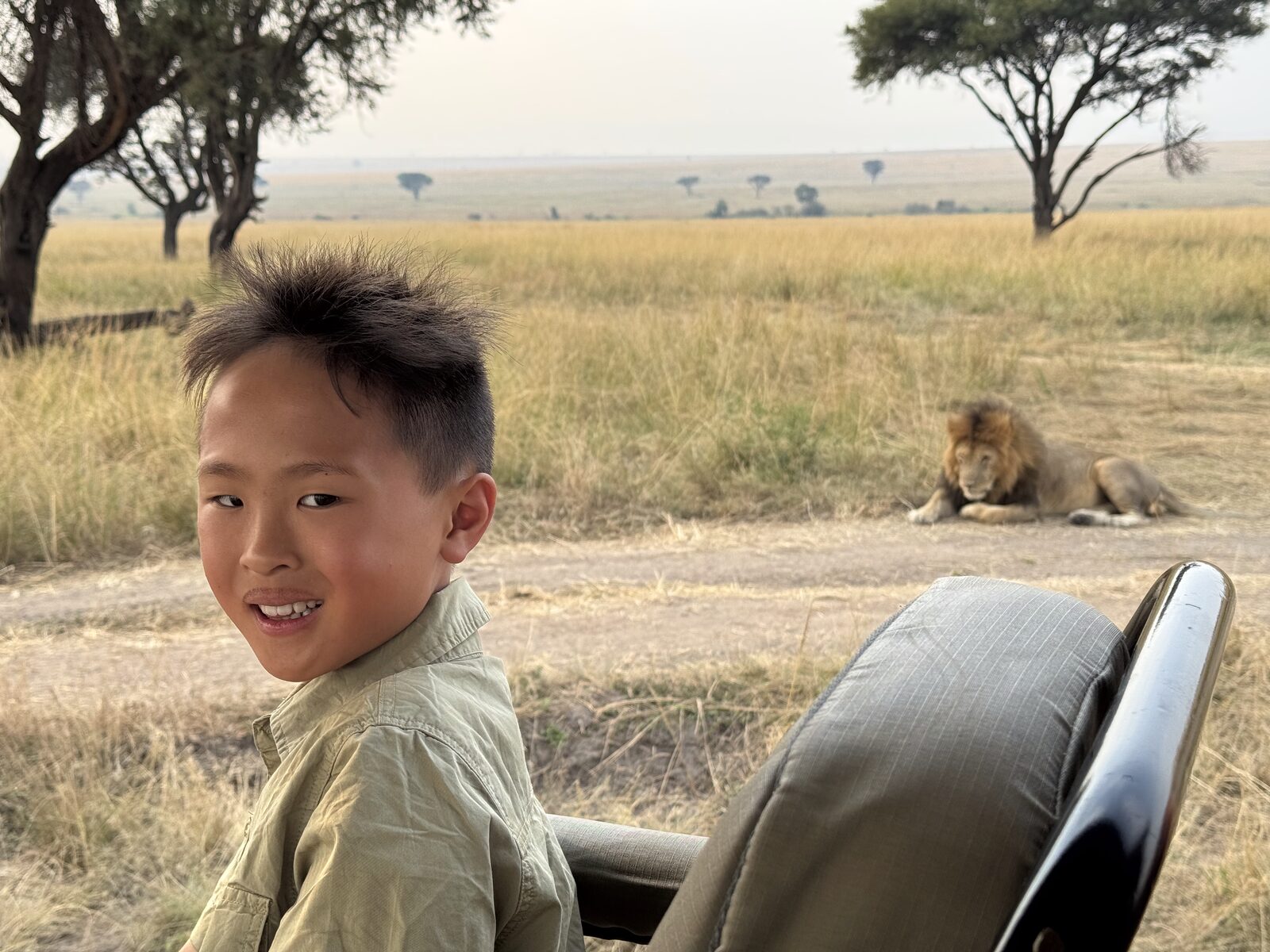
Once it’s set up, Ubuntu is quite comfortable. But you are right among the animals. You hear the lions at night, and you see elephants walking around camp. There were nights I was up recording in the dark because I couldn’t believe the sounds I was hearing. It sounds like it’s right outside your tent, even though our guides assured us the lions and hyenas were probably a mile or two away.
I asked one of the guides who walks guests to dinner whether he had ever met a lion in camp. Of course the answer was yes. He was on his way to pick up guests when he crossed paths with one, so he radioed them to stay inside until he came to get them. I asked him what he does when that happens. His answer: “You never turn your back. You stare it in the eye and make slow movements.”
A showdown with a lion. For our entire stay, I strobed my flashlight 360 degrees as we walked to dinner. My kids thought this was hilarious. It wasn’t hilarious. I was signaling to every animal in every direction that I was here and please stay away. It was me trying to survive.
The crossing points
The crossings are numbered, and from Ubuntu we could reach crossings 4 through 10, according to our guide.
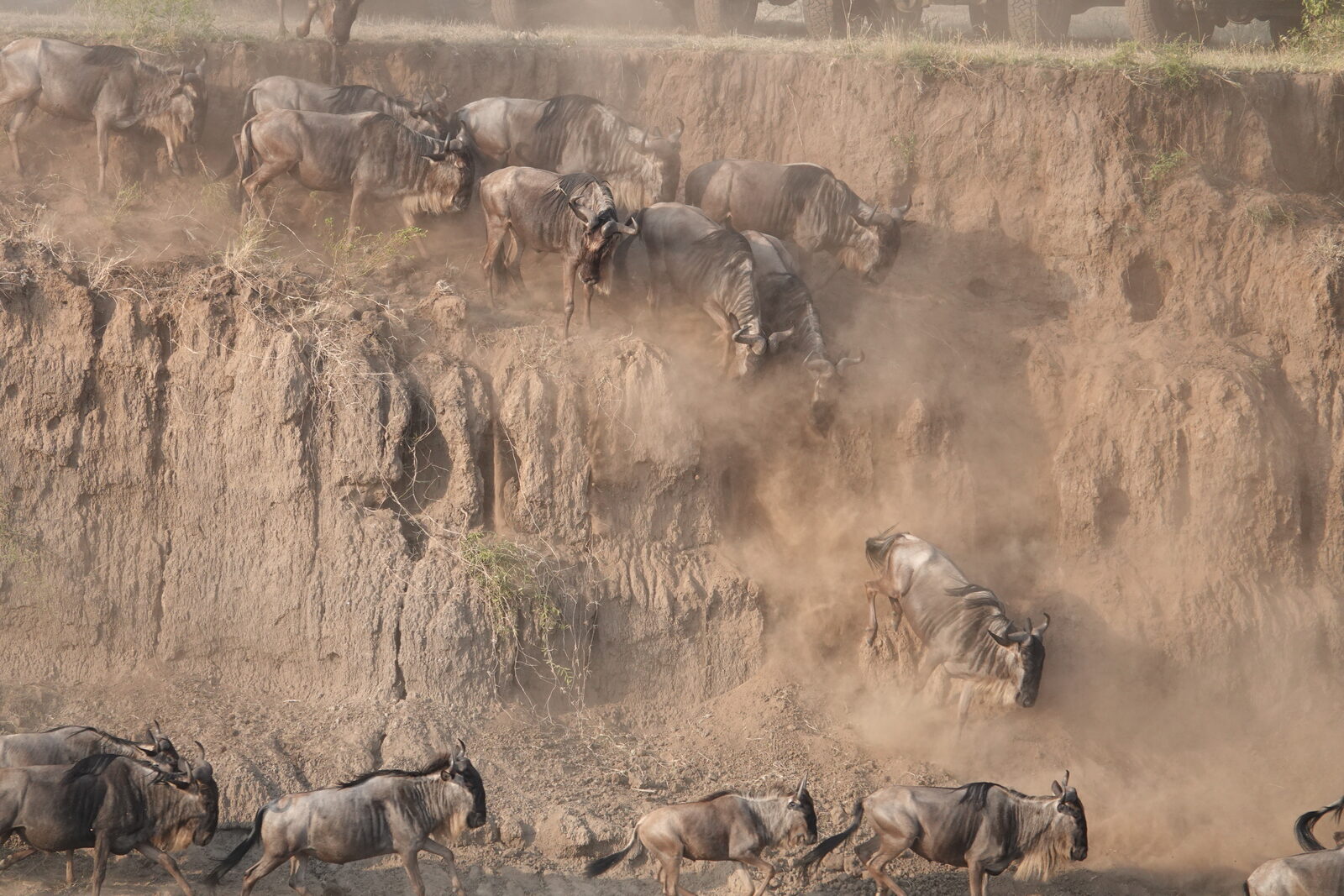
- Crossings 4 to 6 are the classic ones you see in National Geographic and the documentaries: steep, dramatic banks where the wildebeest gather before the mass crossing.
- Crossings 7 and 8 are rocky, with a lot of crocodiles and hippos. You often see wildebeest carcasses here.
- Crossings 9 and 10 are only a couple of minutes from camp.
Day one: the race, and the wait
As soon as we landed at the Lamai airstrip, our very seasoned guide asked whether we needed to go to camp first or were OK heading straight out. There were rumblings on the guides’ shared radio that the wildebeest might be getting ready to cross.
This is what we came for. We had already seen one crossing in the Masai Mara earlier in the trip, so the first thing I told our guide was: no pressure, we’d be happy to see another, but we understand it’s nature. He smiled and told me we hadn’t seen a crossing like the ones from Ubuntu. Boy, was he right.
After the smile, he asked whether everyone was belted in. That should have been my warning. In ten days of safari, nobody had cared whether we wore seatbelts. (I belted my kids in anyway, because they sometimes fell asleep and the vehicles are open.) Those drives were chill cruising compared to this. Once he confirmed we were all buckled, the driver gassed it, and we flew toward the Mara River, racing against time. Dust everywhere. Don’t wear a hat; it will fly off. You just hang on for dear life.
We arrived at crossing 4 or 5, and the wait began. One wildebeest stepped into the water. Everyone behind him watched with curiosity. Then he turned around and climbed back up the bank. We could see thousands of wildebeest, and none of them wanted to go first.
We stayed about two hours, until the sun was setting. The kids had their Kindles, iPads, coloring pages and, of course, their binoculars to check whether anything was starting. Our guide stayed on the radio the whole time, listening for any herd anywhere along the river that looked ready to go. At sunset he told us the wildebeest typically don’t cross in the dark, so we should head back to camp and start early, because the herd had already gathered and could cross any time after daybreak.
Day two: two crossings before lunch
The next morning we raced back to crossing 4 or 5. (Don’t hold me to which one.) On the opposite bank, I counted at least 80 to 100 vehicles lined up. On our side there were maybe 6 to 8. I spent the first ten minutes just gawking at the wall of tourists across the river.
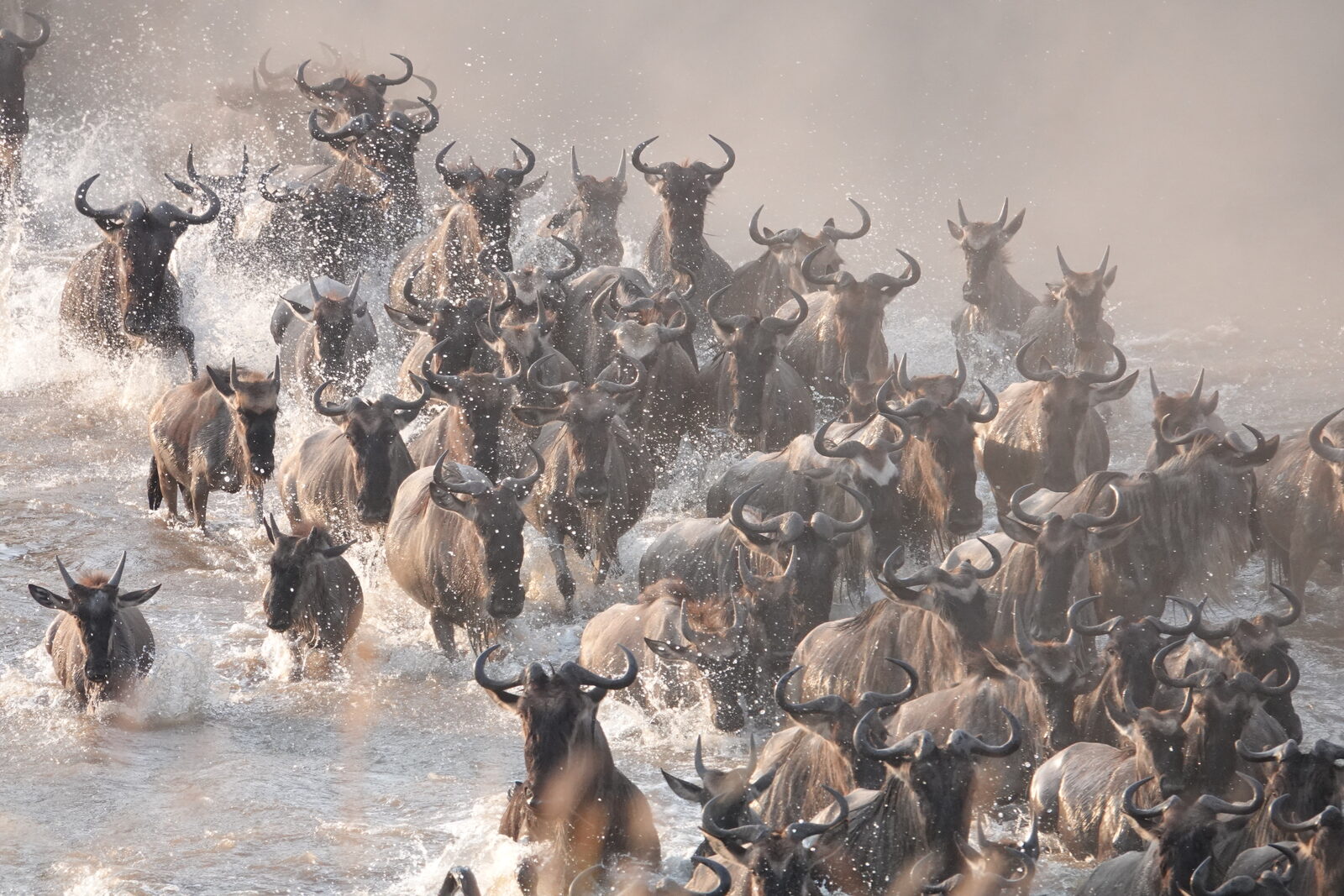
Within 30 minutes of our arrival, one wildebeest stepped in and started to cross. Then another. Then a few more, and suddenly the whole herd was going. And they were crossing toward us. Line by line they swam across, climbed the bank, and surrounded the space around our vehicle.
There are no words for it. The masses jumping off the steep banks, the clouds of dust, the river suddenly filling with wildebeest, and then wildebeest filling every space around our vehicle as they came up. Our jaws dropped. We took videos and photos, and then we put everything down and just experienced it. The whole thing lasted maybe 15 minutes. Experience of a lifetime.
I thought we were done. But our guide got word of a second herd about to cross at crossing 6 or 7, and he rushed us over. Remember, those are the rocky crossings full of hippos and crocodiles. We watched a second crossing, and this time we saw a crocodile take down a wildebeest. I have it on video: I’m filming the crossing, and suddenly you hear my son yell, “Mom, he got him!”
Was it sad to see? Absolutely. Did my kids handle it? Yes, better than I expected. They grew up watching nature documentaries, so much of what we saw on safari was an extension from the screen to real life. That’s what I’d say about safari in Kenya and Tanzania in general: it’s watching the nature documentaries come to life in front of your eyes. We all know the documentaries are real. It’s just very different to see it in person, and unedited. (How we prepared our kids for moments like this gets its own post, coming soon.)
Mara vs. Lamai: what the difference felt like
These two crossings were nothing like the one we saw in the Masai Mara, where we were higher up, farther away, and at an angle, watching a smaller herd. I didn’t know what I was missing until I experienced it. To be right where it happens, and to have the massive herds come up and pass right around you: unimaginable, unparalleled, unmatchable.
What I’d tell you if you want to see a crossing
- Nobody can guarantee a crossing. We waited two hours on day one and saw nothing, then saw two the next morning. We also met families who waited all day and never saw one.
- Give yourself at least three nights in the crossing area. More nights means more chances.
- Where you stay changes what you see. The Lamai Wedge trades some luxury and easy access for far fewer vehicles. For a crossing, I’d make that trade every time.
- Start early and stay flexible. The herds don’t cross in the dark, and a good guide on the radio will move fast when one starts to gather.
- Pack for waiting: books, tablets, binoculars for the kids, and no hats on the drive out.
Experiencing it from the Lamai Wedge was absolutely the right decision. This was the final stop of our 13-night family safari across Kenya and Tanzania.
I hope to book many of you at Ubuntu and put you in the room where it happens. Tell me your kids’ ages and the month you’re hoping to go. If it looks like a fit, I’ll set up a free 20-minute safari call and tell you where I’d put you for the crossings, and how many nights I’d book.